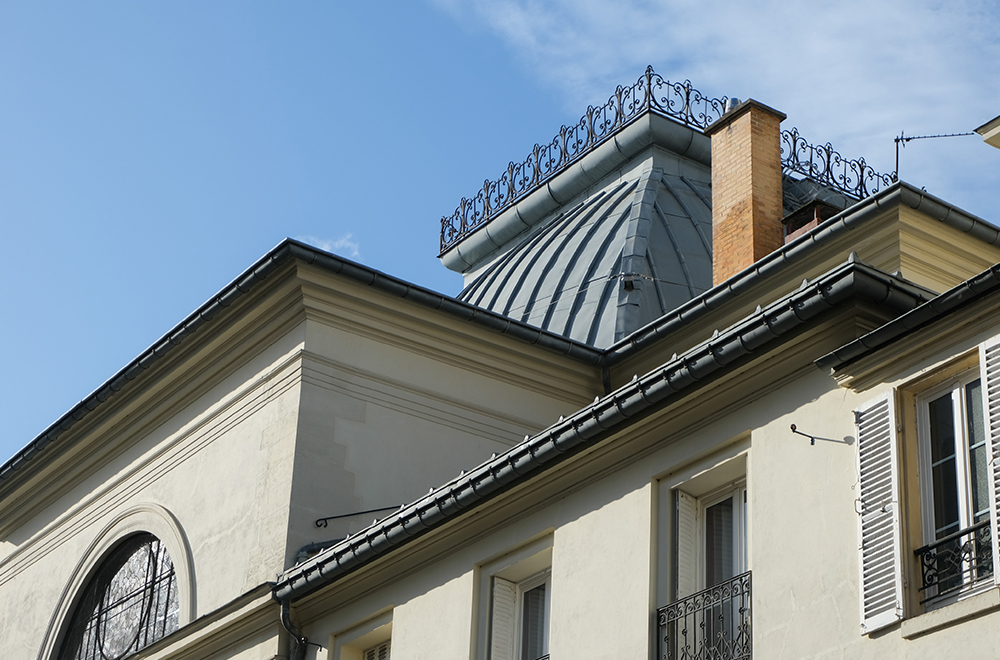

Enfin, en rez-de-chaussée, une seconde suite avec salle d’eau, un salon d’hiver ou home cinéma, une cave à vin voutée, une buanderie et un garage complètent le bien.

A l’extérieur, les demi-niveaux de la maison se répètent avec deux terrasses de 25 m2, tandis qu’au sommet le toit plat entièrement rénové et  végétalisé avec des essences méditerranéennes  de 150 m2 est  accessible par un escalier en acier en colimaçon et s’harmonise avec l’environnement vert qui règne.

Un lieu de synthèse rare entre héritage moderniste, subtilité intime, organique et contemplative.

Henri Pottier

Architecte français majeur de la seconde moitié du XXᵉ siècle, Henri Pottier (1912 – 2000) incarne l’ambition d’une France en reconstruction, moderniste et fonctionnelle. Diplômé de l’École des Beaux-Arts en 1937, il obtient en 1944 le Second Grand Prix de Rome en architecture, distinction prestigieuse qui oriente sa carrière vers les grands projets publics.

Son style, rigoureusement fonctionnaliste, s’inscrit dans la droite ligne des principes de la Charte d’Athènes. Il est particulièrement influencé par les courants modernistes de l’après-guerre.
Henri Pottier est notamment l’un des principaux concepteurs du Front-de-Seine à Paris, vaste opération de rénovation urbaine menée dans les années 1960–70 avec l’architecte Raymond Lopez. Parmi ses œuvres les plus emblématiques, on peut également citer : l’Auditorium Maurice-Ravel à Lyon (1975), réalisation marquante dans un langage brutaliste et sculptural ou encore la Tour Les Poissons à Courbevoie, symbole d’un urbanisme planifié aux références cosmiques.

Malgré cela, Pottier est reconnu pour son rôle fondamental dans la modernisation des infrastructures françaises, et son œuvre incarne les trente glorieuses, avec ses espoirs, ses excès et ses contradictions.

COLOMBES

Located in the North-West of Paris after Asnières-sur-Seine and Bois-Colombes, the city of Colombes is the largest residential city in the inner suburbs of Paris.

Particularly well served by public transport, Colombes is the eleventh municipality of Île-de-France and the fourth municipality of Hauts-de-Seine. The historic heart is crossed by rue Saint-Denis, pedestrianized and lined with many shops. Its territory is rich in an industrial past and a particularly varied architectural heritage with mansions, beautiful bourgeois residences, 19th century holiday villas, residential housing estates or even beautiful architecture from the 1930s such as the former Hôtel des Postes by François Le Cœur in 1928.
The town benefits from several attractive green spaces such as the Pierre Lagravère park located on the banks of the Seine. The cultural and sporting offer is not to be outdone thanks to the Avant-Seine theater whose program delights young and old and the Yves-Du-Manoir sports complex, famous for having hosted the Summer Olympics in 1924 and soon, the field hockey events during the 2024 Olympic Games.

A destination of choice for families looking for a more spacious place to live.

MASQUE COLOMBES 4
MASQUE COLOMBES 5

LE PRÉ SAINT-GERVAIS

Bordered by Pantin, the 19th arrondissement and the Lilas, Le Pré-Saint-Gervais is the Ile-de-France town closest to Paris.

Carried away by his momentum, the Parisian who runs on a Sunday morning from Belleville to Pantin, will pass by Le Pré-Saint-Gervais without even noticing it… With 70 hectares of area, Le Pré-Saint-Gervais is the smallest town in ‘Ile-de-France.

Built on a meadow, the village offers the remains of a country walk, which Parisians came to do there in the 19th century, as well as workers’ workshops from the 20th century. Bamboo houses, atypical volumes, brick houses, narrow paths, vaulted porches… the architecture gives a particularly popular atmosphere to the “Pré”.

A veritable open-air laboratory, it hosts a park that combines greenery and street art, a market, part of which is covered, a village square that has a southern air and, recently, six shared gardens. Everything is good to create a family spirit and bring Gervaisiens together!

A very lively small town retaining its old charm.

MASQUE 4 PRE SAINT-GERVAIS
MASQUE 5 PRE SAINT-GERVAIS

ASNIÈRES-SUR-SEINE

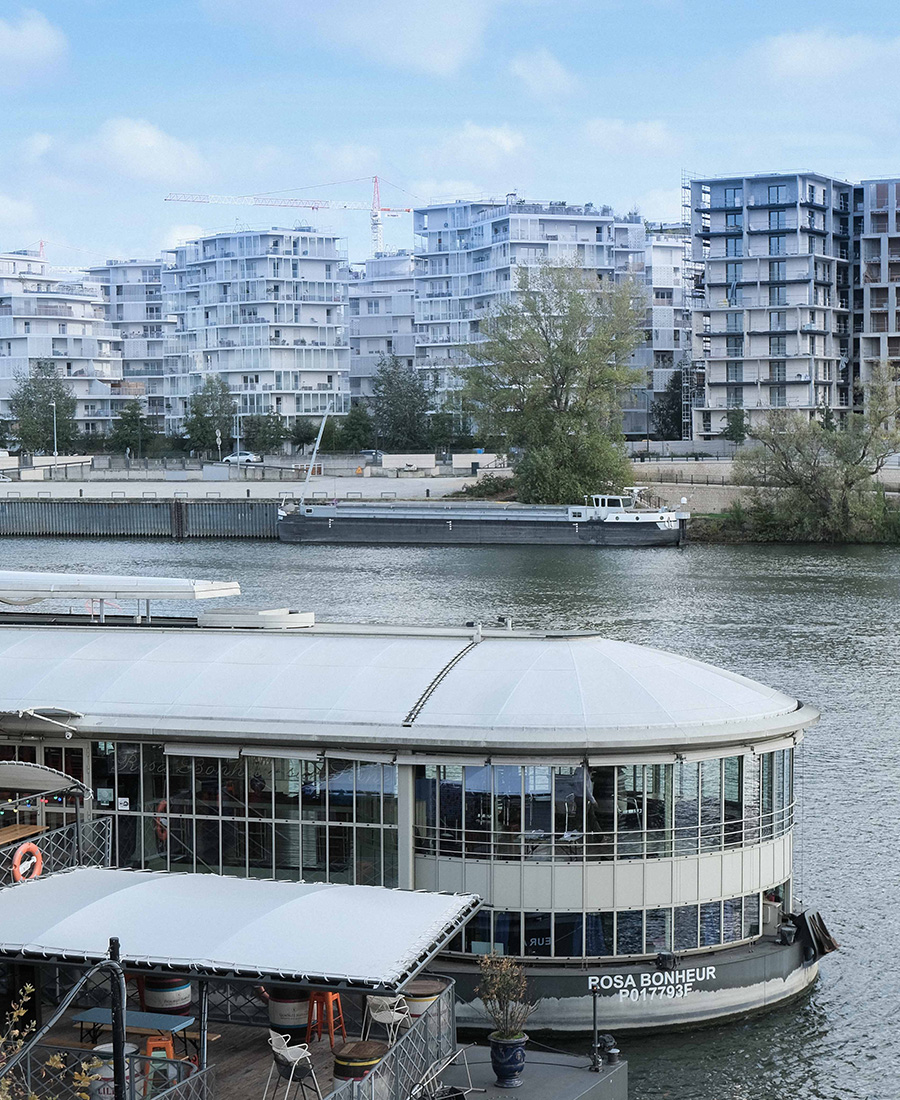
Bordering the left bank side of the river, the town of Asnières-sur-Seine is located in the northwest suburbs of the capital, thus benefiting from a strategic location.
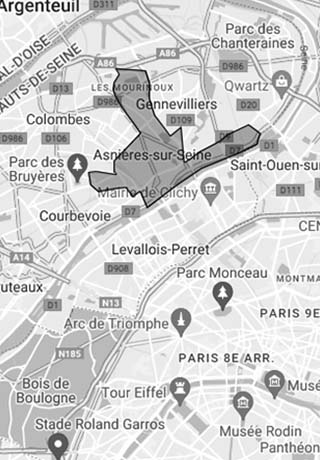
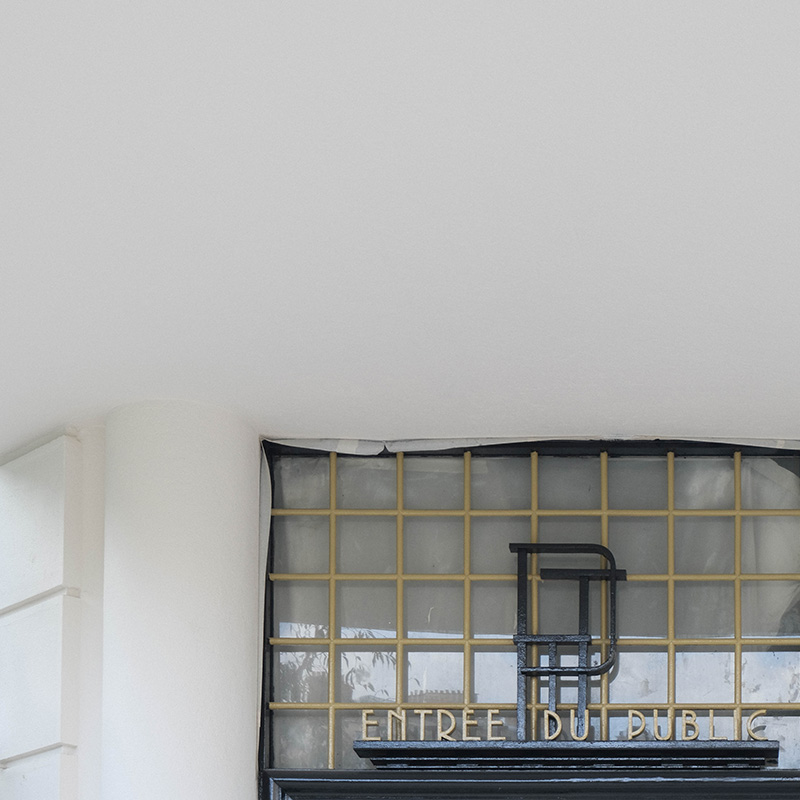
Rich of an architectural heritage spanning the ages, Asnières-sur-Seine is full of monuments and places that bear witness to the city’s prosperous past: from the Neolithic era, with its menhir located in the Square du Maréchal Leclerc, to the 18th century with its castle, emblem of the city, and also masterpieces from the Art Nouveau era with the house of Monsieur Vuitton or from the Art Deco era with the facade of the Main Post Office.

Its inner city around the train station remains the most sought-after district for its accessibility, its shops and its charm, while the west of the city hosts beautiful bourgeois residences from the beginning of the 20th century which are the most popular.

In terms of transport, the city is one of the most accessible of the inner suburbs, with a metro line (and soon an additional line as part of the Grand Paris Express) as well as two train lines connecting Saint-Lazare station in 7 minutes from downtown.

A small particularity has made it famous: the first cemetery of the modern era intended for pets, inaugurated in 1900, located in Robinson Park which runs along the banks of the Seine. Another green space of interest is the Square Leclerc located behind the Town Hall.
archik-immobilier-architecture-city-guide-asnieres 4

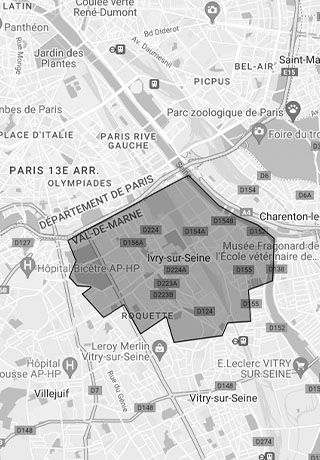
IVRY-SUR-SEINE

Barely 5 km from Paris, Ivry-sur-Seine is a multicultural commune offering a rich architectural diversity linked, in part, to its industrial past.

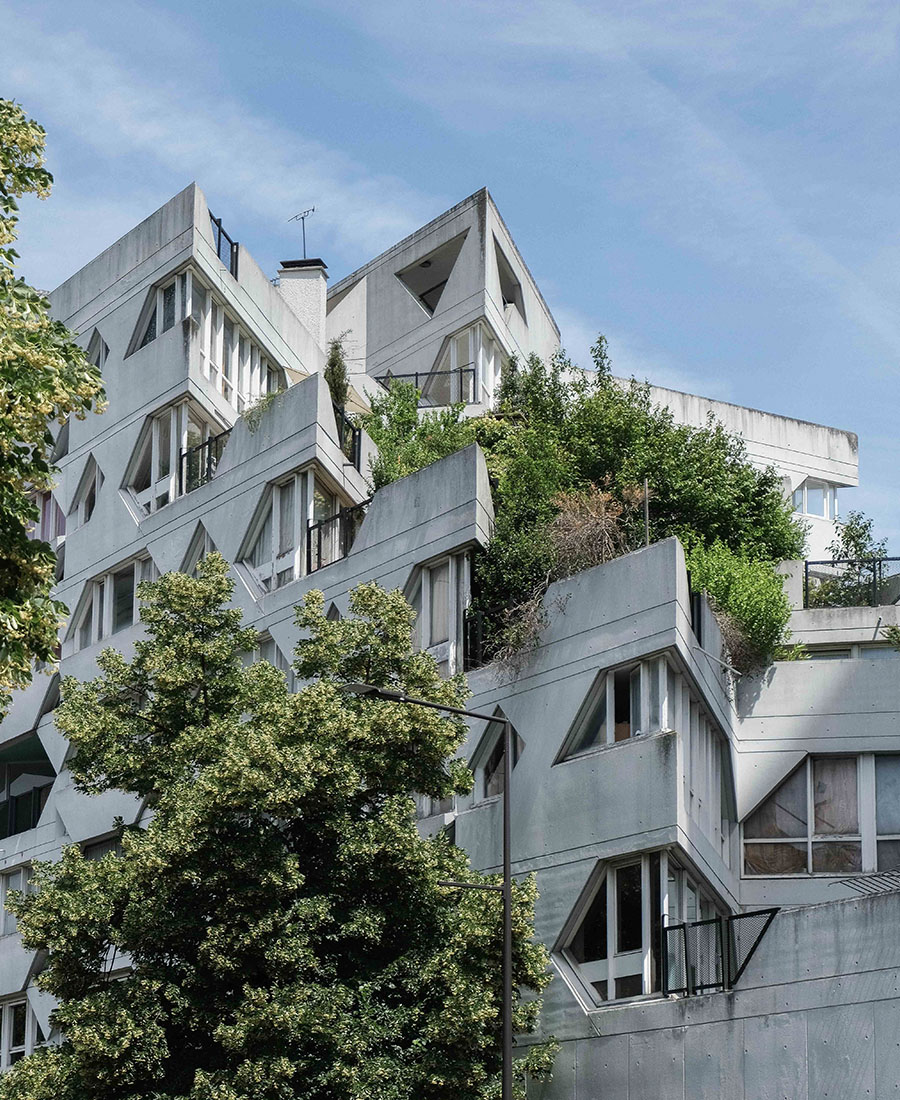
The town, which borders the capital, is impressive for its geometrically shaped, non-conformist buildings, which give the architectural landscape a dynamic character.
On the Place de la République, you can see the Jeanne Hachette residential tower, an emblematic figure of the Beauvais resistance in the 15th century. This work was designed by Renée Gailhoustet, the city’s chief architect at the time. In collaboration with Jean Renaudie, she completely rethought the town centre’s urban plan. This project gave rise to the Jeanne Hachette shopping centre, for which it is internationally renowned.
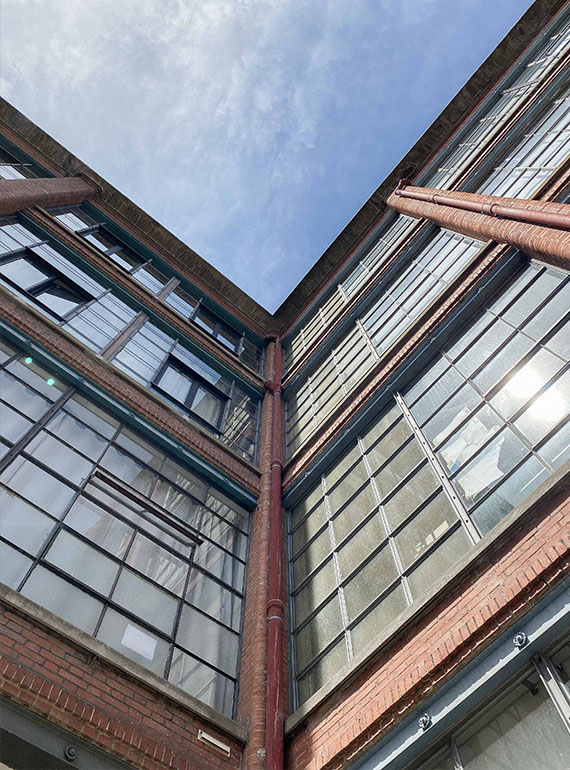
Ivry-sur-Seine is a resolutely attractive town with its shops, markets and cultural centres such as the Manufacture des Œillets theatre and its eclectic programme. The city has also preserved its heritage linked to the manufacturing industry. Today, its renovated loft buildings create a contrast between industrial and modernist constructions.

A culturally rich city, which offers an ideal living environment for families or young people.

CITY-GUIDE-IVRY-SUR-SEINE-4
CITY-GUIDE-IVRY-SUR-SEINE-5

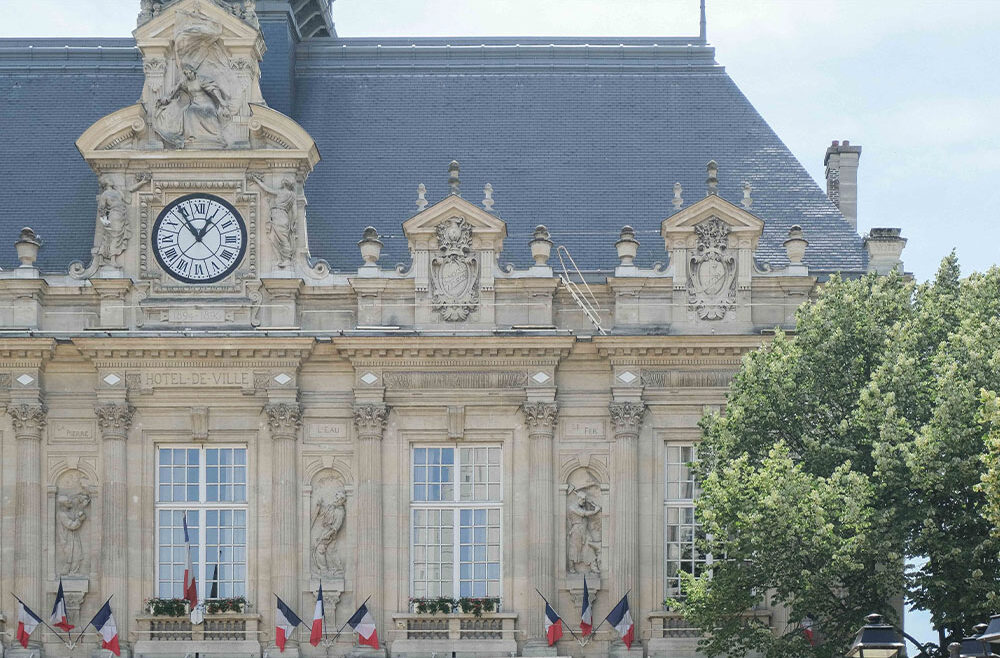
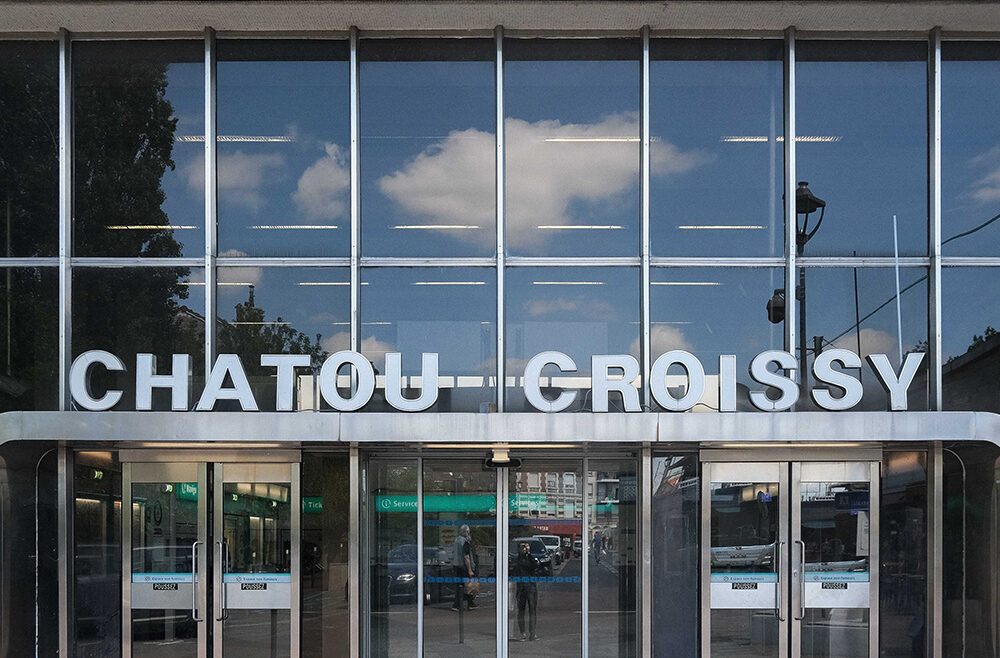
CHATOU

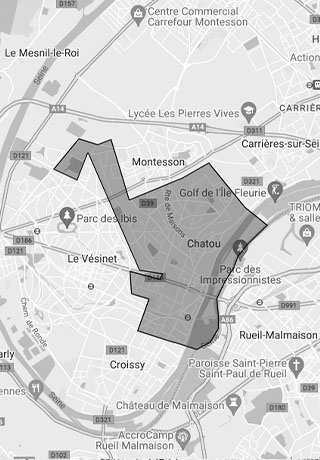
Near Paris and the Hauts-de-Seine department, Chatou, the town of the Impressionists, enjoys an ideal environment between the Seine and the countryside.

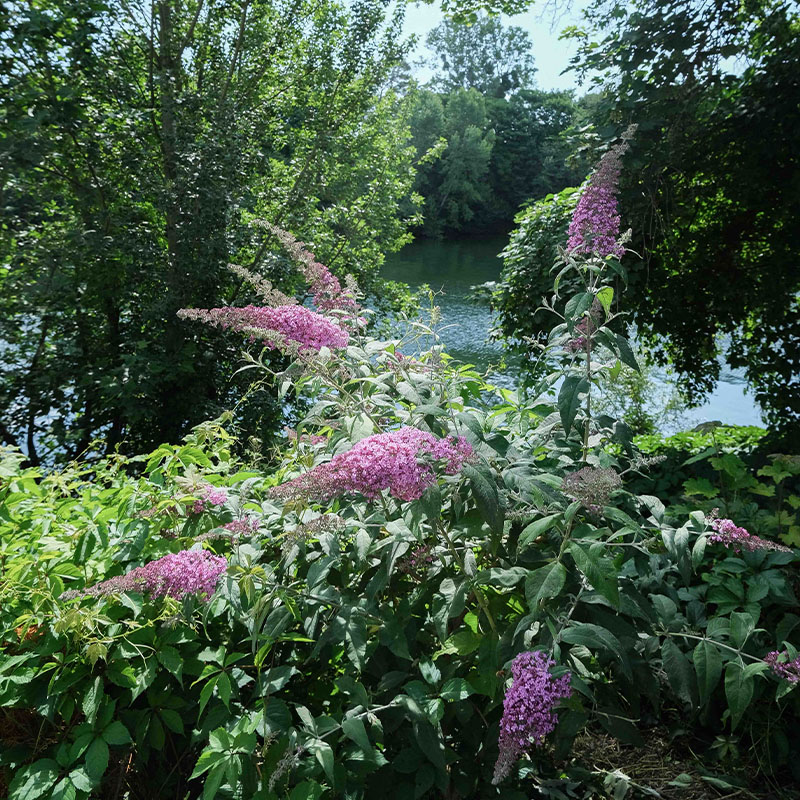
Entering the city via the Chatou bridge, the magic of the city is instantly apparent thanks to the change of scenery offered by the banks of the Seine and its deep blue-green reflections. It is in this natural setting, between river, greenery and dance halls that impressionism was born. Renoir, Monet and Manet all immersed themselves in this changing environment where the play of light inspired their art. The arrival of the railway, linking Saint-Lazare to Le Pecq, transformed Chatou into a playground for artists and became a holiday resort for Parisians fleeing the capital.
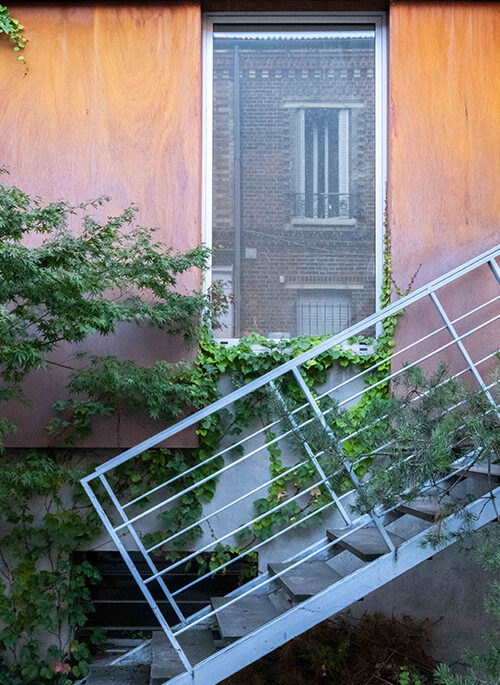
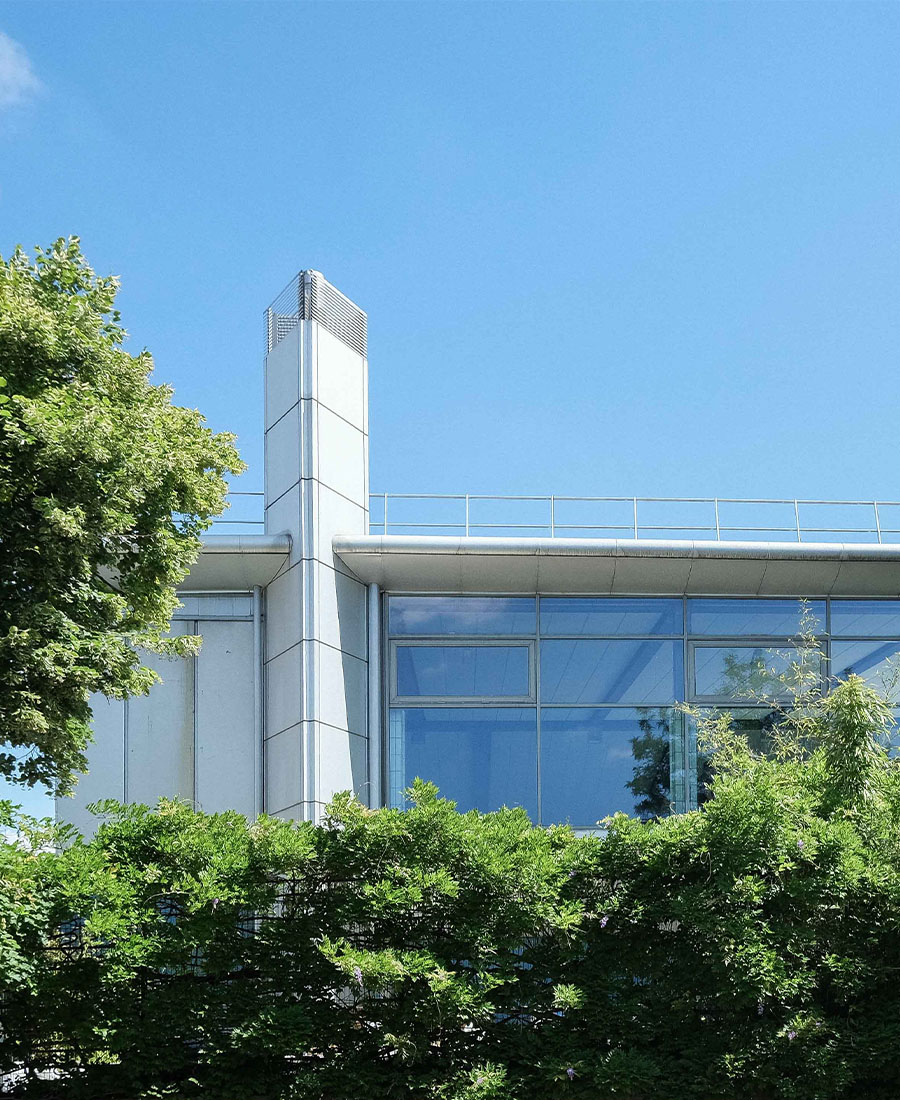
Today, the town is firmly rooted on the banks of the Seine, with the Île des Impressionnistes, its banks and its effervescent antique and ham fair, a must for lovers of antiques and design. The commune offers a peaceful and pleasant living environment with its many schools, its market and its restaurants. It is not to be outdone in terms of culture and is home to the La Fournaise museum and the emblematic Louis Jouvet cinema. The Maison Levanneur is home to the Galerie Bessières, a modern art gallery exhibiting international artists such as Shawn Huckins, Stephen Ormandy and Christopher Kuhn.
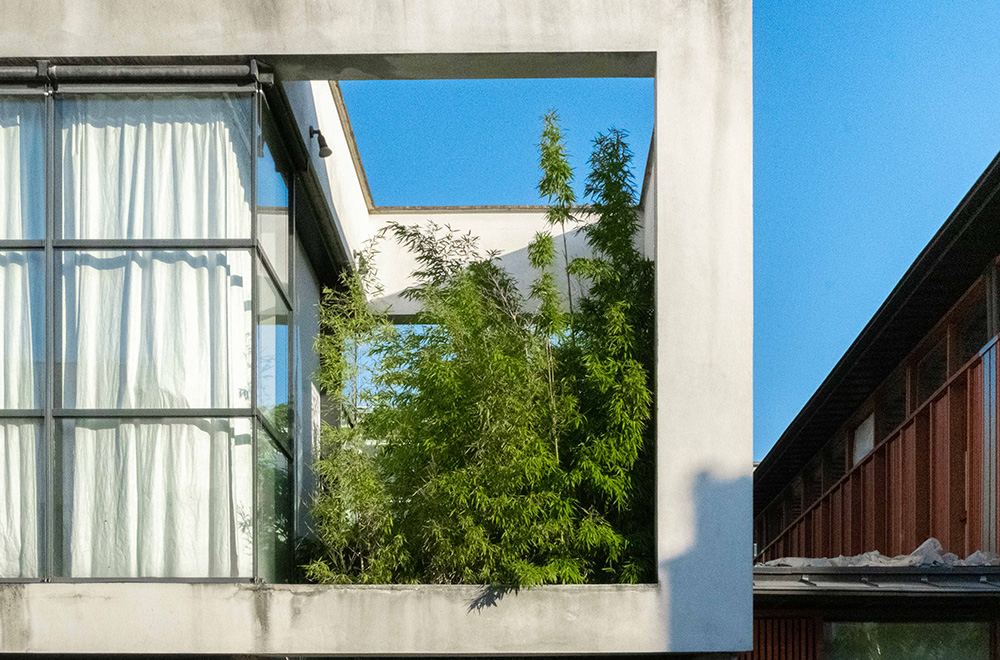
A charming city, steeped in history and culture, conducive to a peaceful family life.

CITY-GUIDE-CHATOU-4
CITY-GUIDE-CHATOU-5

Sous une hauteur de plus de 5 mètres, cette pièce déploie ses volumes tout en courbes. Son parquet en hêtre, ses colonnes, sa bibliothèque sur mesure en pitchpin et sa mezzanine reprenant les codes d’une coque de bateau et donnent le la de cette belle partition architecturale. Baignée de lumière grâce à sa grande ouverture en forme de voile, elle ouvre sur le jardin intimiste et confortable, à la façon d’un jardin secret au calme absolu qui ne demande qu’à être investi. En retrait de l’espace de vie, s’aperçoit la vaste cuisine / salle à manger et un espace buanderie éclairés par la lumière du sol en verre du premier niveau.

Enfin, aux deux niveaux supérieurs se trouvent les espaces nuits avec cinq belles chambres dont une parentale, ponctuées par endroits de courbes et dont certaines se parent d’incrustations vitrées allégoriques comme signature de cette maison-bateau. Elles se partagent deux salles de bain et une salle d’eau.

Une œuvre architecturale hors norme à proximité de la vie parisienne.

Jacques-Émile Lecaron

Né à Paris en 1939, Jacques‑Émile Lecaron est un architecte français formé à l’École spéciale d’architecture, puis à Harvard, où il obtient un master en urbanisme. Influencé par des figures comme Frank Lloyd Wright, Buckminster Fuller ou Bruce Goff, il développe une approche originale mêlant architecture, poésie et imagination.

Installé à Clamart depuis les années 1970, il y conçoit une série de maisons singulières – telles que la Maison d’acier, l’Arche de Noé ou la Maison de la Belle au bois dormant – dont les formes colorées et narratives traduisent les rêves et les personnalités de leurs habitants. Il réalise aussi des aménagements urbains et œuvres publiques, en lien étroit avec leur environnement.

Lecaron se distingue par une architecture expressive, presque onirique, qui refuse les normes pour mieux raconter des histoires. À travers ses créations, il propose une autre manière d’habiter : plus libre, plus intime, et profondément humaine.

MONTREUIL

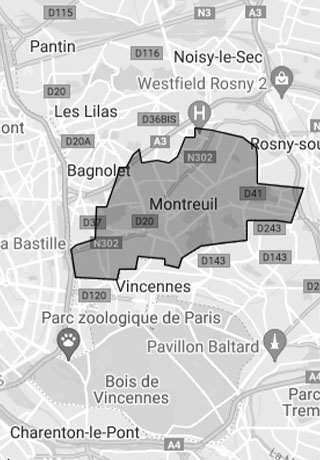
Bordering the 20th arrondissement, Montreuil is both a popular and trendy city.

Montreuil is a municipality located in the department of Seine-Saint-Denis and the Metropolis of Greater Paris. Formerly known as Montreuil-Sous-Bois, it now offers a pleasant living environment, away from the hustle and bustle of Paris. You can enjoy the lively neighbourhood life, the small shops and the unique properties that are hidden away. One of Montreuil’s great qualities is its abundant cultural programme. Indeed, the city is home to numerous theatres and cinemas, testifying to the town’s attachment to the performing arts, such as the new theatre, Le Lieu, a modern architectural work by Dominique Coulon.

Its green spaces, such as the Montreau and Beaumonts parks and the Parc départemental les Guilands, give Montreuil an air of the countryside, making it ideal for sports activities or relaxation.

Montreuil offers a balanced lifestyle to its inhabitants. Culturally rich, it will appeal to film buffs, its restaurants and its green spaces will charm epicureans in search of calm.

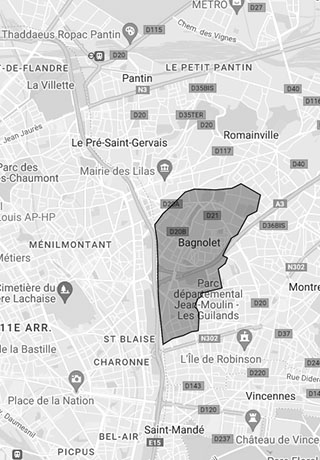
BAGNOLET

At the gates of eastern Paris, bordering the 20th
arrondissement, lies the urban yet peaceful commune of Bagnolet.

Bagnolet, a town in the Seine-Saint-Denis region, is developing and asserting itself as one of the most dynamic towns in eastern Paris. Urban planning projects such as the Grand Paris are contributing to its renewal, with a city centre undergoing major changes. Today, the city offers a modern and attractive living environment.

Among its assets, its remarkable vitality! From the Bel’Est shopping mall to local shops and lively markets, you have everything you need to liven up your day. Thanks to its many parks, the city has a green environment to practice sports and activities of your choice. Its modern business districts, such as the Mercuriales towers, and its residential areas make Bagnolet a pleasant place to live, a few steps away from the Ménilmontant and Père-Lachaise districts. Renowned for its street art and the festival dedicated to it, the city is also home to numerous buildings with coloured and artistic facades, much to the delight of local residents and street art lovers.

Bagnolet is a city with a strong identity, its dynamism and its green spaces charm families, young workers and seniors looking for tranquillity.

Photos credits ⓒMarie-Yandé Fall

CITY-GUIDE-BAGNOLET-4
CITY-GUIDE-BAGNOLET-5